
The Sunday Signal: First the office. Now the factory. Everything is next.
Jeff Bezos has $100 billion and a plan to automate heavy industry. The last assumption of safety just collapsed. Issue #46 | Sunday 22 March 2026

The Bottom Line Up Front
65,700.
That is how many roles have been eliminated or marked for elimination in the first eleven weeks of 2026. Not over a year. Not over a cycle. Eleven weeks.
AI is not starting at the bottom of the labour market. It is starting in the middle. And the pace is not slowing. It is accelerating.
This week has three stories, and they belong together.
The first is the Yorkshire Post column published this week. The Full Monty was about Sheffield steelworkers who lost the thing that defined them. This time it is bankers, analysts, lawyers and accountants facing the same structural shock. The white-collar professional class assumed its credentials would protect it. They will not.
The second story is the one that changes the terms of the debate entirely. Jeff Bezos is in early-stage talks to raise up to $100 billion for a fund designed to buy established manufacturers and overhaul them with AI. Chipmaking. Aerospace. Automotive. Defence. The people who told you that physical, hands-on work was safe from this wave were reasoning from the last one. Bezos just confirmed, with the most ambitious private investment thesis in history, that they were wrong.
The third story is what happens when the office and the factory go at the same time. The economics, the social fracture, and the governance crisis no government is prepared for.
The Sunday Signal Tech and AI Layoff Tracker returns below, with a significant new entry from the banking sector that makes the direction of travel impossible to ignore.
You can also listen to The Sunday Signal as a weekly podcast using a voice cloned from my own voice, a demonstration of the same AI capabilities I write about. Listen on Spotify, Apple Podcasts, and YouTube.
Story One: The Full Monty Was About Steelworkers. This Time It’s Bankers.
This week’s Yorkshire Post column, adapted for The Sunday Signal.
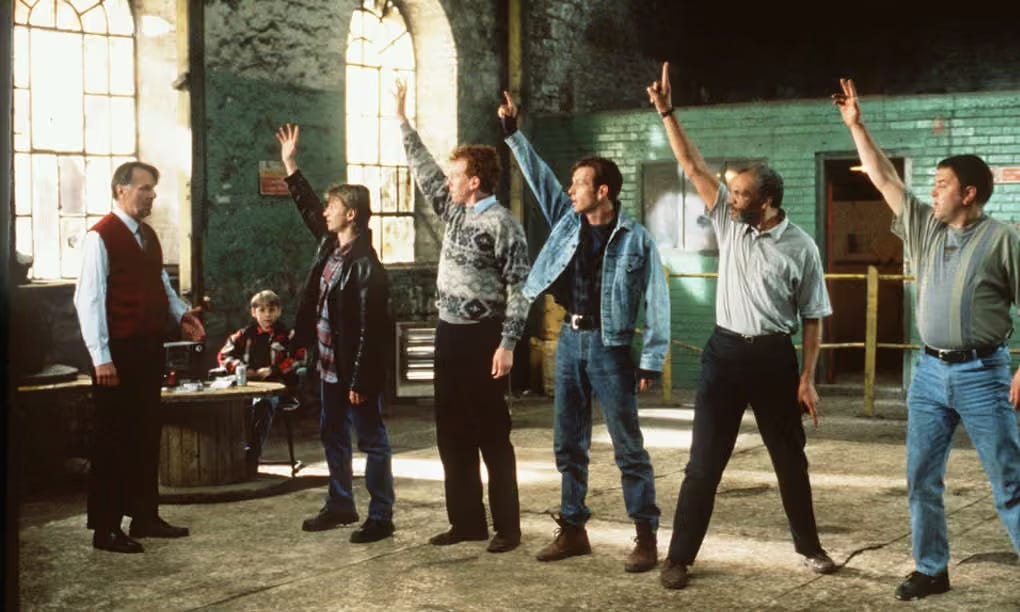
The remake opens in 2036.
A glossy corporate film flickers on screen. The City of London at sunrise. Glass towers glowing. Young analysts moving at speed between meetings and markets. Screens flashing. Deals closing. A voiceover promises that for those with talent and drive, finance will always reward human judgment.
Then it stops.
Silence.
The trading floor is empty. Screens are dark. The work has not moved to New York or Singapore. It has not been outsourced. It has simply dissolved into software.
In the corner, two former bankers in scuffed Loakes are trying to wrench a server from its rack, hoping to strip copper from the very machines that replaced them.
It sounds far-fetched. Until you remember we have seen it before.
The original Full Monty was not about abstract economic forces. It was about Sheffield steelworkers who lost the thing that gave them identity, pride and purpose. When the work went, it did not just take wages. It took status, structure and meaning.
For a generation, that kind of shock was understood as a working-class problem. Something that happened to people who worked with their hands. White-collar professionals assumed they were insulated. Degrees, offices and credentials were meant to protect them.
That assumption is now breaking down.
In the first eleven weeks of 2026, major technology companies have announced or are developing cuts totalling approximately 45,724 roles, based on tracker-aggregated estimates from Layoffs.fyi and RationalFX. That number is already out of date. By the time you read this, it has crossed 65,700. The developing stories, including HSBC and the heavily reported Meta cuts, suggest the real figure is still climbing.
Behind the headlines, something more important is happening. Roles are not being replaced. Teams are not being rebuilt. The first rung of the career ladder is quietly being removed.
AI is not starting at the bottom of the labour market. It is starting in the middle. Software, finance, business operations and law dominate usage. And the gains increase with complexity. The more educated and valuable the task, the more it can be accelerated.
The real shift is not speed. It is what happens to the job itself.
When AI takes over drafting, analysis, coding or planning, what remains for the human is the lower-value residue. Coordination. Oversight. Exception handling. The job does not vanish overnight. Its intellectual core erodes.
The steel industry followed exactly this path. Technology did not simply replace workers. It redefined the work, broke skilled roles into simpler tasks, and reduced the economic value of labour over time.
That same dynamic is now moving through the office.
The clearest signal is not layoffs. It is hiring. Firms are no longer creating the entry-level roles that once trained the next generation. The ladder is not being climbed. It is being removed.
And when you remove the first rung, you do not just lose jobs. You break the system that produces experience, judgment and expertise.
When deindustrialisation swept through cities like Sheffield, the people most affected did not have the influence to force a rapid response. The adjustment came late, and often in the form of retraining programmes that never quite matched the scale of the problem.
The professional class will insist its work is different. It always does.
Right up to the point where it is not.
Story Two: Bezos Has $100 Billion and He Is Coming for the Factory
The assumption that physical work is safe just collapsed.
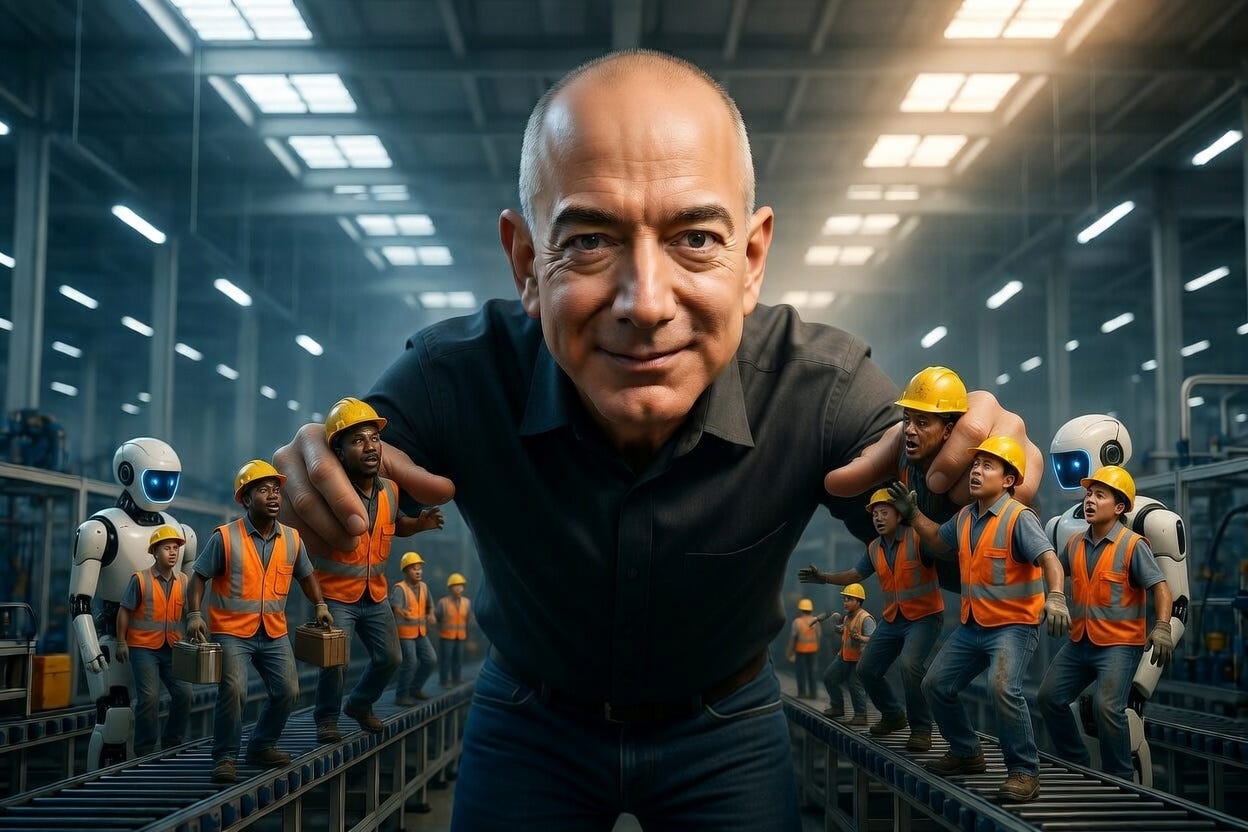
There is a comfortable argument that many in manufacturing still reach for.
Software jobs, yes. Finance, perhaps. But you cannot automate a factory. You cannot AI your way through a chipmaking line. The physical world is different.
It is not different.
Jeff Bezos is in early-stage talks to raise up to $100 billion for a new investment vehicle. The pitch documents, as reported by the Wall Street Journal on 19 March and confirmed by Reuters, the New York Times, Forbes and Bloomberg, describe it as a “manufacturing transformation vehicle.” The strategy is brutally simple: buy established manufacturers in chipmaking, defence, aerospace and automotive, then overhaul them with AI. Not gradually. Decisively.
The fund operates alongside Project Prometheus, Bezos’s secretive AI startup co-founded with former Google X executive Vik Bajaj. Prometheus is not building a chatbot. It is building what its team calls Physical AI: models that understand and simulate real-world physics, engineering and manufacturing processes. Airflows. Stress points. Thermal dynamics. The things that govern how physical objects are made, tested and repaired.
Prometheus launched in November 2025, received $6.2 billion in initial funding, and Bezos serves as co-CEO. His first operational executive role since stepping down at Amazon in 2021. That detail tells you everything about how seriously he takes this.
The $100 billion fund would give Prometheus something a laboratory cannot provide: real factories, real supply chains, real workforces to transform.
The scale is historic. The only comparable private fund ever raised is SoftBank’s original Vision Fund in 2017, also $100 billion. But SoftBank bet on startups. Bezos is betting on established industrial businesses and replacing their operating model with AI. That is not a venture bet. That is a restructuring of the physical economy.
Bezos has been personally on the roadshow. Sovereign wealth funds in the Middle East. Asset managers in Singapore. No money has closed yet. But the ambition is not a rumour.
The direction is clear: fewer people, more machines, longer operating hours, and a shift from labour to systems. Not incremental improvement. Structural replacement.
Consider what this means for the jobs we assumed were protected by their physicality.
Manual assembly: replaced by multi-purpose robotic arms running continuous shifts. Quality control: replaced by AI computer vision that detects microscopic defects faster and more consistently than any human inspector. Logistics: managed by autonomous mobile systems. Maintenance: directed by AI copilots overlaid on the physical hardware through augmented reality, reducing the need for years of accumulated trade expertise.
The roles that survive are systems engineering and orchestration. High-demand. High-skill. Numerically small.
Last week I described the one-person unicorn: companies generating extraordinary revenue with workforces of dozens rather than hundreds. Cursor, Midjourney, Gamma. That model was about software. Bezos is extending it to chipmakers, aerospace manufacturers and automotive plants. The same logic. A different industry. A bigger disruption.
Previous waves of automation replaced specific machines. A lathe. A press. A welding arm. Everything else remained human. Project Prometheus is designed to replace entire factory ecosystems. Not the weld. The whole floor.
There are 425,000 unfilled manufacturing roles in the United States right now that require AI literacy. The jobs that will survive this wave already exist. The problem is that the current workforce does not yet have the skills to fill them, and the retraining infrastructure to close that gap does not yet exist at anything approaching the scale required.
The people who told you the physical world was safe were reasoning from the last wave. This is a different wave.
Story Three: The Robot Tax Is Coming. And It Will Not Be Enough.
The economic and social consequences of simultaneous displacement.
Governments are already talking about a robot tax. A levy on automated output. A charge on compute. A payroll equivalent paid by companies that replace workers with machines. The debate is live in Brussels, in Sacramento, in Westminster. It sounds like a solution.

It is not a solution. It is a symptom. A sign that the fiscal foundation of the modern state is cracking and policymakers are reaching for the nearest available tool.
Here is why it matters, and why it will not be enough on its own.
Every previous wave of automation has had a partial quality to it.
The loom replaced hand-weaving but left the mill. The assembly line replaced craftsmen but created line operators. The spreadsheet replaced clerks but created accountants. In every case, displacement was sector-specific. New roles absorbed the shock, eventually, if imperfectly.
What Bezos is building, alongside the AI-native software companies I described in recent issues of this newsletter, is something without clear historical precedent. Simultaneous displacement across both the white-collar professional economy and the physical manufacturing economy. Not sequentially. At the same time.
The economics are stark.
Manufacturing is the last refuge of labour arbitrage. For decades, if wages rose in one country, production moved to another. Vietnam. Indonesia. Mexico. The competitive advantage of low-cost human labour has kept hundreds of millions employed in the developing world and provided a brake on wage deflation in the West.
That brake is about to be released.
If an AI-run factory in Yorkshire costs the same to operate as one in Vietnam, because the primary input is no longer human labour but electricity and chips, production comes home. Not because of trade policy or political will. Because of arithmetic. And when that happens, the entire logic of globalisation begins to unwind.
This creates something economists are only beginning to model. A manufacturing renaissance in wealthy nations, accompanied by severe economic disruption in developing ones. Countries that have spent fifty years building export manufacturing capacity will find that advantage evaporate. That is not a domestic British story. It is a global destabilisation event.
At home, the social impact follows the fault line I have been tracking in this newsletter since Issue #40.
The High-Agency tier thrives. Engineers, AI orchestrators, systems architects. People who direct these systems rather than operate within them. Their leverage is extraordinary. A small team managing a Prometheus-driven production line can outperform a workforce of hundreds.
The Displaced Tier faces something harder than unemployment. It faces irrelevance. A factory foreman with thirty years of floor knowledge. A bank analyst with a first from Durham. The AI replacing them is not approximating. It is outperforming, consistently, at a fraction of the cost.
There is a governance crisis buried in these numbers that governments are not yet confronting at the scale the problem demands.
If forty to fifty per cent of manufacturing employment is automated alongside significant white-collar displacement, the income tax and national insurance base fractures. The modern state is built on taxing labour. Remove labour, and you remove the foundation. Everything else is detail. The debate about a robot tax, a compute levy, or a tax on AI-generated output is not a theoretical policy question. It is a fiscal emergency arriving in slow motion.
And underneath the economics is something the data cannot capture.
Sheffield in the 1980s was not just an unemployment story. It was a meaning story. Work is not merely income. It is identity, structure and purpose. The Full Monty was not about poverty. It was about what men become when the thing that defined them is taken away.
We are about to run that experiment again. Simultaneously. Across every class, every sector, every region.
The handloom weavers of 1810 could see the machines arriving. They understood what would happen. Their response has been misrepresented by history as mindless rage against progress. It was not. It was a demand that progress should not come at the cost of people who had no other options. That demand was ignored.
We should be very careful about ignoring it again.
The Sunday Signal Tech and AI Layoff Tracker
Updated weekly. Sources: Layoffs.fyi, TrueUp.io, RationalFX, Reuters, Bloomberg. As of Sunday 22 March 2026.
Total roles eliminated or reported for elimination in 2026: approximately 65,700.
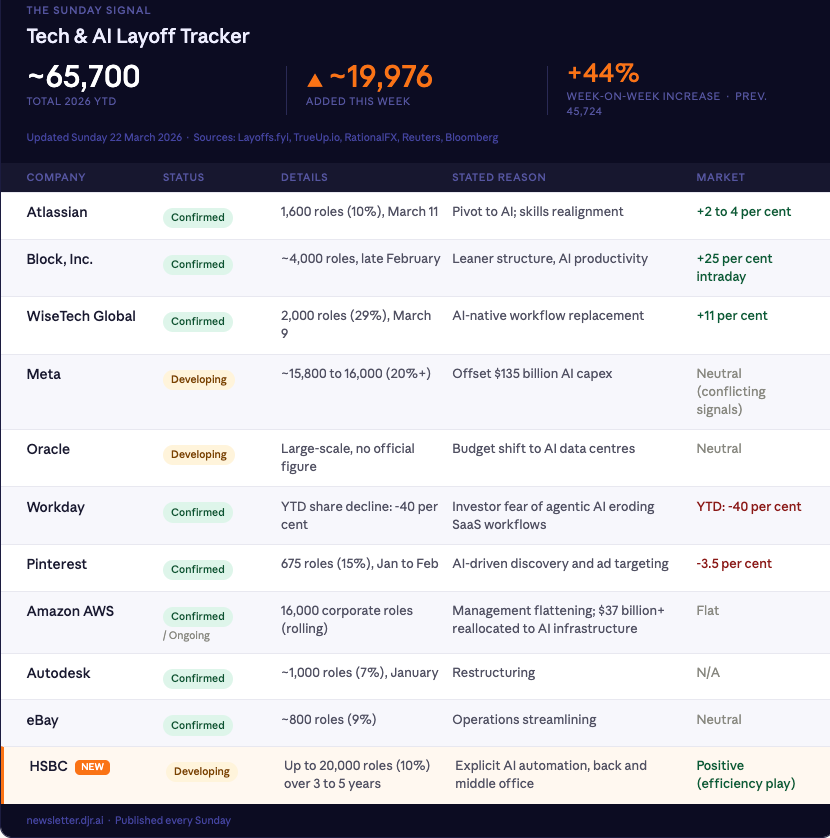
Up from 45,724 as of 14 March. The most significant new entry this week is HSBC, which disclosed plans to reduce its workforce by up to 20,000 roles, explicitly citing AI automation in back and middle office functions. This is the first globally systemically important bank to name AI as the mechanism of reduction in formal planning documents. It will not be the last.
Meta and Oracle remain in developing status, with Meta in particular carrying heavy internal confirmation signals for cuts of 15,800 to 16,000 roles tied directly to the reallocation of its $135 billion AI capital expenditure programme.
The pattern is consistent across every confirmed entry. Every company that has made an explicit cut tied to AI has seen its share price rise or hold. Block surged 25 per cent on the day of its announcement. WiseTech gained 11 per cent. Atlassian rose between 2 and 4 per cent. The market is not mourning these jobs. It is pricing in the leverage.
HSBC is a different signal. Layoffs at a software company, however large, can be rationalised as sector-specific. A globally systemically important bank, operating across 62 countries, telling regulators and investors that AI will eliminate one in ten roles, explicitly, as a plan rather than a possibility, is a different category of event. Finance was meant to be complex enough to resist this. HSBC has now answered that assumption directly.
🚀 Final Thought
Last week I wrote about the one-person unicorn. The company that generates a hundred million in recurring revenue with a workforce measured in dozens. That story was about software. This week, Bezos has extended the same thesis to steel, chips, aerospace and automotive.
The physical world is not different. It is just next.
The Luddites did not stop the loom. But the political pressure they generated, the social disruption they created, eventually produced the Factory Acts. Child labour protections. Workplace safety law. The early architecture of a social contract between capital and labour. The machine won. But it forced a renegotiation.
What we need now is not a fight against AI. It is a serious, adult, politically difficult conversation about what the social contract looks like when the machine can do the job better than the human. About who owns the productivity gains. About what replaces the purpose that work once provided.
That conversation is not happening at the scale the problem demands.
It will happen eventually. The only question is whether we start it now, while choices still exist, or wait until the factory floor is dark and the trading floor is empty, and two former bankers are stripping copper from a server rack.
Until next Sunday, David
David Richards MBE is co-founder of Yorkshire AI Labs, a weekly columnist for the Yorkshire Post, and the author of The Sunday Signal. Published every Sunday at newsletter.djr.ai.
Listen to this week’s episode on Spotify, Apple Podcasts, and YouTube.
