
The Sunday Signal: Slaves to the Machine. And We Built It Ourselves.
You trained the AI that is coming for your job. You did not know. That is the problem. Issue #47 | Sunday 29 March 2026

The Bottom Line Up Front
You were turned into unpaid labour before you were replaced.

Then you trained the system that made you redundant.
This is not a warning about what is coming. It is a description of what already happened.
This week runs three stories and they belong together. The reCAPTCHA case: how hundreds of millions of people spent fifteen years building AI training data while thinking they were proving their humanity. The Great Compression: how the global offshore software industry trained its own replacement and is now watching the valuation collapse in real time. And the Jensen Huang prescription: the most important career distinction anyone in knowledge work will hear this decade.
The layoff tracker closes it. 74,500 roles in 2026. Eight thousand eight hundred of those went in the last seven days. We are three months in.
Listen to this issue as a podcast. Available on Spotify, Apple Podcasts, and YouTube.
Part One: The Traffic Light That Stole Your Labour
Every week I write a column for the Yorkshire Post. This week’s column stopped me cold as I was writing it.
Most of you have spent years clicking on traffic lights, crosswalks, and fire hydrants to prove you are human. You did this hundreds of times. Possibly thousands. You found it mildly irritating. You assumed it served you.
It did not.
reCAPTCHA, launched by Carnegie Mellon professor Luis von Ahn in 2007, was ingenious. One word you solved proved your humanity. The other word, scanned from a book a machine could not read, was your unpaid labour. You transcribed it. You moved on. Google acquired the company in 2009 and pointed those millions of human answers at the New York Times archive, thirteen million articles back to 1851, then at Google Books. By 2011, the world’s literary heritage was digitised. By humans. Without a contract in sight.
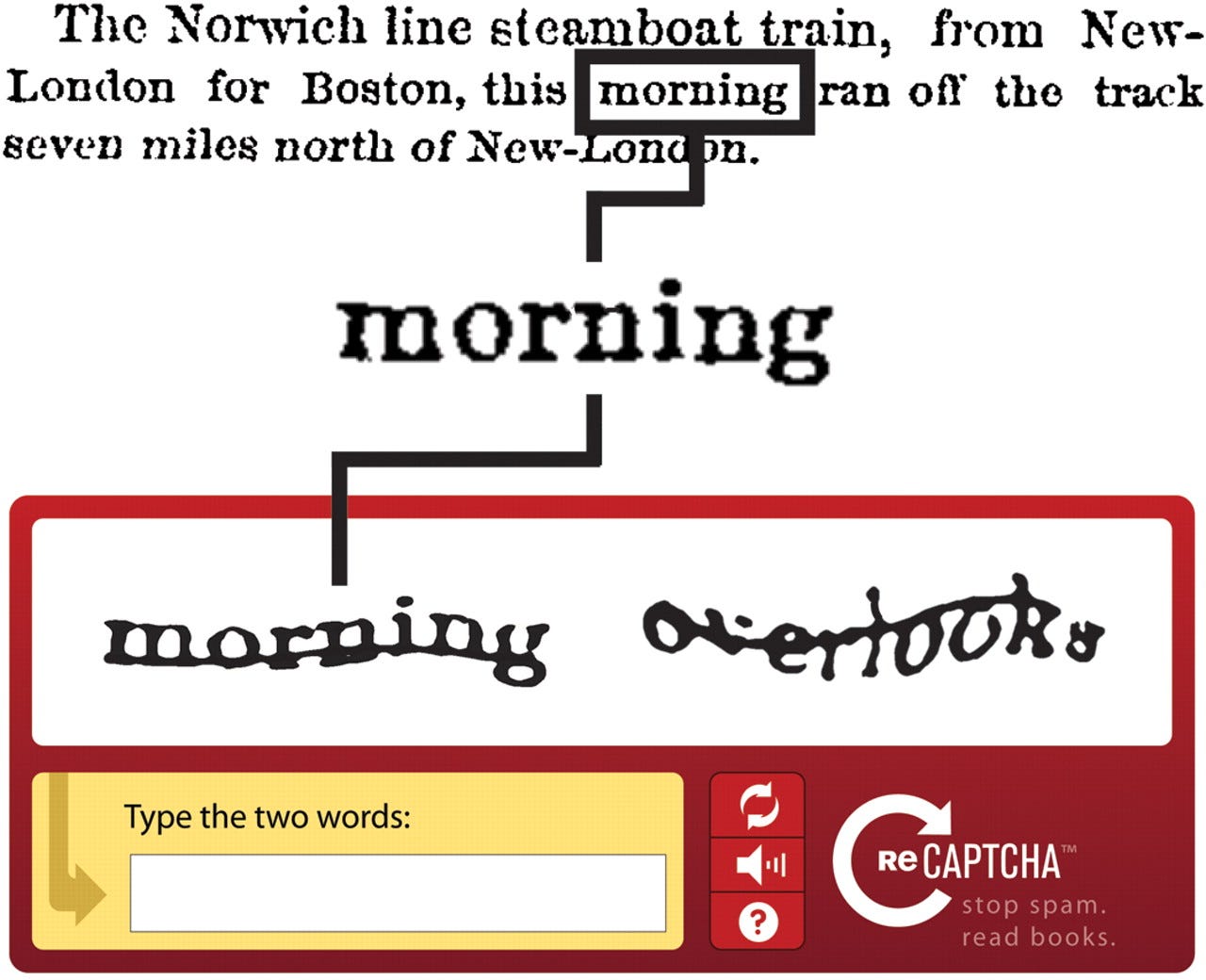
Then the work changed. By 2012 the words were replaced by image grids taken from Google Street View. Every click told a machine what a traffic light looks like. Where a pedestrian crossing begins. Where a road ends. You were not passing a test. You were annotating the visual world for free.

You thought you were logging in. You were clocking in.
A 2023 study by the University of California, Irvine calculated that reCAPTCHA had extracted 819 million hours of unpaid human labour. Worth at least $6.1 billion in wages never paid. Among other things, it helped build Waymo, Google’s self-driving car business, valued at $126 billion as of February 2026.
Today reCAPTCHA v3 does not even show you the grid. It watches how you move your mouse. How you scroll. How long you pause between keystrokes. Whether you move in the jerky, slightly irregular pattern of a human or the smooth, precise arc of a script. Your behaviour is the training data. You cannot see the task. You cannot refuse it. You are not even aware it is happening.
It is not a test you pass. It is a tap left running.
This is not a test. It is a production system. And you are inside it.
There is a word for a system that extracts productive labour from people without the meaningful ability to refuse it. We have historically used that word carefully. 819 million hours makes it less abstract.
I have spent thirty years in this industry. I worked directly alongside the people who built this stuff in Silicon Valley. I advised governments on where it was heading. I did not know this was happening until recently.
I told my son. He shrugged.
“Yeah,” he said. “I just assumed that’s what they were doing.”
That exchange should stop us cold. I was oblivious. He took it for granted. No outcry. No class action. No parliamentary debate. Billions of hours of human labour extracted without a signature, a disclosure, or a penny in return.
We debate endlessly about what AI will do to us. But here is the truth nobody wants to say out loud: before the AI era has properly begun, we were already conscripted into building it. Without consent. Without payment. Without even noticing.
That was the warm-up act. The main event is worse.
Part Two: The Great Compression. You Trained Your Replacement.
What happened quietly on the internet is now happening loudly in the labour market.
reCAPTCHA was passive. You did not know you were doing it.
What has happened to the global software development industry over the last three years is active. Deliberate. And the people doing it were praised every step of the way.
The architect who automated himself out of existence
A senior backend architect. Two hundred and eighty thousand dollars a year. Six months spent building AI-enhanced developer tools for his team. He trained the junior developers on Cursor. Set up the Claude integrations. Automated the code reviews. Built, by his own account, something exceptional.
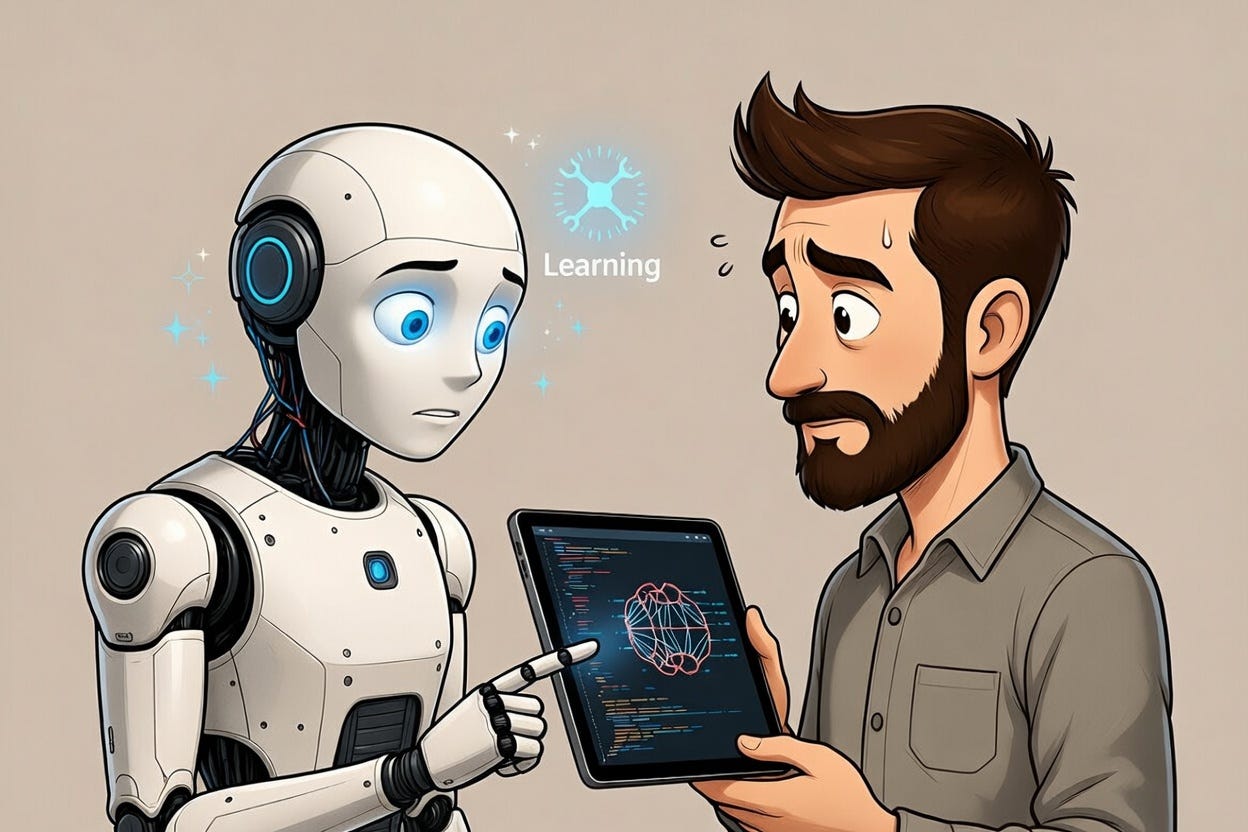
What he did not realise was that management was watching very carefully. Not his output. The AI’s output.
The platform he built could handle 73 per cent of the platform’s complexity with zero human oversight. The remaining 27 per cent was routed to a contractor in Romania at twenty-eight thousand dollars a year. The math was not complicated.
His manager pulled him aside. “Your AI tools work so well we don’t need the team anymore. Just the tools.” They kept two people out of eleven. He was not one of them.
His performance review, filed before the restructure, said: “Exceptional work on AI integration. You’ve revolutionised how we approach development.”
He automated himself out of existence and got praised for it.
The same story unfolded at Stack Overflow. The co-founder, on a package north of four hundred thousand dollars, was managed out after building the AI training pipeline that ingests developer conversations. His replacement was the pipeline he built plus an eighty-nine-dollar-a-month API subscription. The irony is suffocating.
These are not anomalies. They are the template.
The Great Compression
For two decades, the offshore model was the unquestioned infrastructure of global technology. The math was straightforward: why pay a US junior developer ninety thousand dollars when you could hire four developers in Bangalore for the same price? The result was the Pyramid. One expensive onshore architect managing dozens of offshore workers handling boilerplate code, manual testing, documentation.
Then came the Copilot trap.
Between 2023 and 2024, tools like GitHub Copilot and ChatGPT were rolled out to offshore teams under the banner of productivity improvement. It worked. Offshore developers used AI to finish tickets faster. Every accepted suggestion, every corrected bug, every documentation comment was captured as training data.
The offshore teams were teaching the models how to do their own jobs.
By 2025, the routine work that justified the offshore model, the 70 per cent that was repetitive and well-defined and easily specified in a Jira ticket, was exactly what the AI had become perfect at. Companies began realising that the pyramid model no longer required most of the pyramid.
The Pyramid collapsed into a Pillar.
Headcount was the product. Now the product is the system.
Today the model is called agent-shoring. Instead of sending work to people in other countries, companies send it to autonomous AI agents. A digital teammate costs twenty to one hundred dollars a month. Even the cheapest offshore developer costs two to three thousand dollars a month when management overhead and infrastructure are included.
The 70 per cent that was offshore is now automated. The 30 per cent that remains needs one senior person to oversee the agents. In many organisations, that person is not even in-country.
The economic stakes
This is not a technology trend. It is a labour market event. And it has already started.
India’s IT sector contributes close to 10 per cent of GDP. Software exports account for over two hundred billion dollars annually. More than five million people employed directly. The tech campuses, the apartment blocks, the schools, the entire consumer economy of Bangalore, Hyderabad, Pune: all of it premised on continued demand for human developers. Entry-level hiring has dropped approximately 30 per cent in 2026. The ladder has been removed from the bottom. You can still reach the top. You just cannot get on.
The Philippines built its middle class on call centres. Klarna’s AI assistant now handles the equivalent of 700 full-time customer support agents. That is not a rounding error. That is the signal.
Eastern Europe supplied a generation of nearshore engineering talent. EPAM, Globant, Endava: business models built on the premise that skilled developers in Poland, Romania, and Ukraine could undercut Silicon Valley. That arbitrage is closing. Not because those developers have become less skilled. Because the AI has become skilled enough.
The human cost of living is not moving to match the agent. And unlike previous waves of displacement, there is no obvious alternative runway. The new jobs are not being created at the rate or in the locations where the old ones are disappearing. The timeline is compressed. The geography is wrong.
What the stock market already knows
Investors understood this before most analysts did.
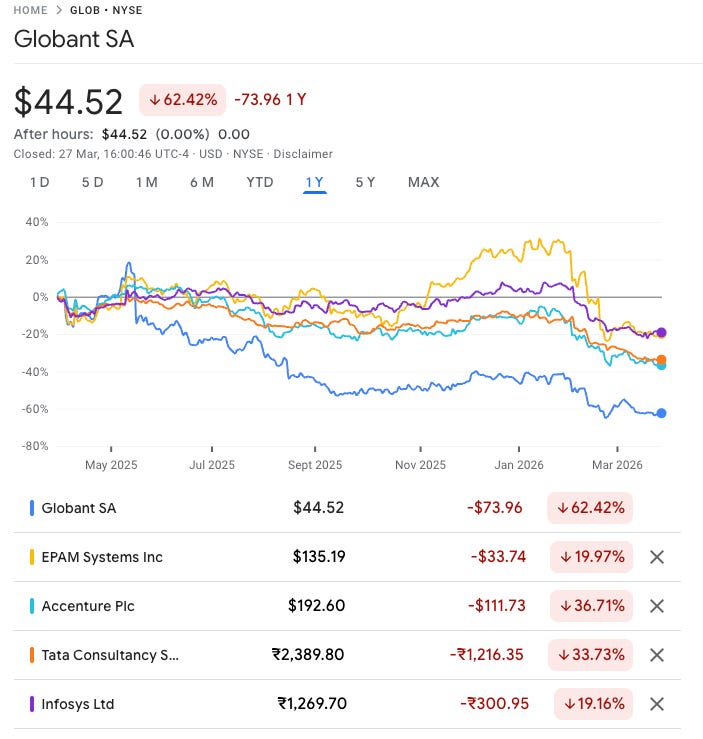
EPAM Systems, long regarded as the gold standard for high-end software engineering, saw a 16 per cent single-day decline in February 2026 on cautious organic growth guidance. The trajectory of broader IT services firms tells the same story: the S&P BSE IT index fell sharply in February as investors began questioning the moat of headcount-based revenue models entirely.
Globant, EPAM, Accenture, TCS and Infosys all felt the pressure. Some have pivoted effectively. Accenture, large and diversified enough to reframe itself as AI infrastructure, has held up better than most. The pure-play offshoring firms that still monetise primarily through the number of bodies in seats are being punished by the market with no sign of reprieve.
Valuation multiples for the sector have normalised to around 9.8 to 10.5 times EV/EBITDA, down from pandemic-era highs of 15 times or more. The “seat model” is being priced out of existence.
The market is not predicting disruption. It is pricing the disruption that has already arrived.
Part Three: Jensen Huang Drew the Line. Which Side Are You On?
Jensen Huang said something this week that should cut through every career conversation happening in British business right now.
The Nvidia CEO, speaking on the Lex Fridman podcast, did not hedge.
“If your job is the task, then you’re very highly going to be disrupted.”
Not might be. Not eventually. Very highly going to be.
If your job is the task, you are already late.
That single distinction between a job and a task is the most important career diagnosis anyone will hear this decade. If you show up every day to execute a repeatable process, you are the process. And the machine runs processes better than you. Faster. Cheaper. Without breaks. Without errors. Without a salary negotiation.
The moment your role can be written as a checklist, the checklist gets automated. Your desk gets cleared.
Huang did not stop at the diagnosis. He handed you the prescription in the same breath.
“If your job’s purpose includes certain tasks, then it is vital that you go learn how to use AI to automate those tasks.”
Your job includes tasks. But your job is not the tasks.
Your job is the judgment around them. The decisions. The context. The instinct for why the work matters and what to do when everything breaks. That stays human. Everything else gets handed to the machine.
And the person who hands it over first does not lose their job. They become more valuable than everyone still doing it by hand.
What Huang is really saying
Disruption warnings have been everywhere for a decade. People discount them. What makes this different is the specificity. Huang runs the company that makes the hardware inside every significant AI system on the planet. He is not guessing. He is reading his own order book.
And note what he did not say. He did not say the people who learn to use AI will be safe. He said the people who use AI to automate their tasks will be more valuable. That is a narrower, more demanding claim. Using AI passively, running prompts, generating first drafts, does not move you up the value chain. It makes you marginally more productive at the tasks being automated anyway. The move he is prescribing is active. You identify the repeatable components of your work. You hand them to the machine. You use the time to go deeper on the work that cannot be written as a checklist.
The accountant who automates data entry becomes the strategist. The marketer who automates reporting becomes the creative. The person who refuses to automate anything becomes the most expensive way to do the cheapest work. That line is drawing itself right now, in every organisation in the country.
What the shift actually looks like for software developers
The market for people who simply write code is contracting. The value has moved to those who design the workflow, audit the output, and own the judgement.
The new stack of skills that separates the replaceable from the indispensable:
Move from executor to orchestrator. Learn agentic IDEs, Cursor, Windsurf, Claude Code. The skill is no longer syntax. It is context engineering: knowing exactly what documentation, architectural patterns, and business rules to feed the AI to get a working result.
Move up to systems thinking. AI can build components. It cannot reason about why you should choose one architecture over another for a specific scaling constraint. That requires trade-off analysis, distributed systems knowledge, and organisational context. None of it can be specified in a Jira ticket.
Build vertical domain expertise. AI is a generalist. If you know everything about fintech compliance, or healthcare data edge cases, or legacy COBOL systems, you become the guardrail for the agent. That is not replaceable. That is the last mile.
Master the AI-native stack itself. RAG and vector databases. AI evaluation frameworks. Multi-agent orchestration tools like LangGraph and CrewAI. If you can build the system, configure its guardrails, detect when it is hallucinating, and fix its reasoning path, you are indispensable. If you can only use the system, you are its product.
Develop non-automatable human skills. Complex negotiation. Stakeholder management. The ability to sit in a room with a sceptical CEO and explain what is actually happening. AI cannot navigate office politics, cannot empathise with a frustrated client, cannot convince a board to change strategy. Engineers who understand UX and revenue are substantially more valuable than those who only understand the repository.
The six-month roadmap
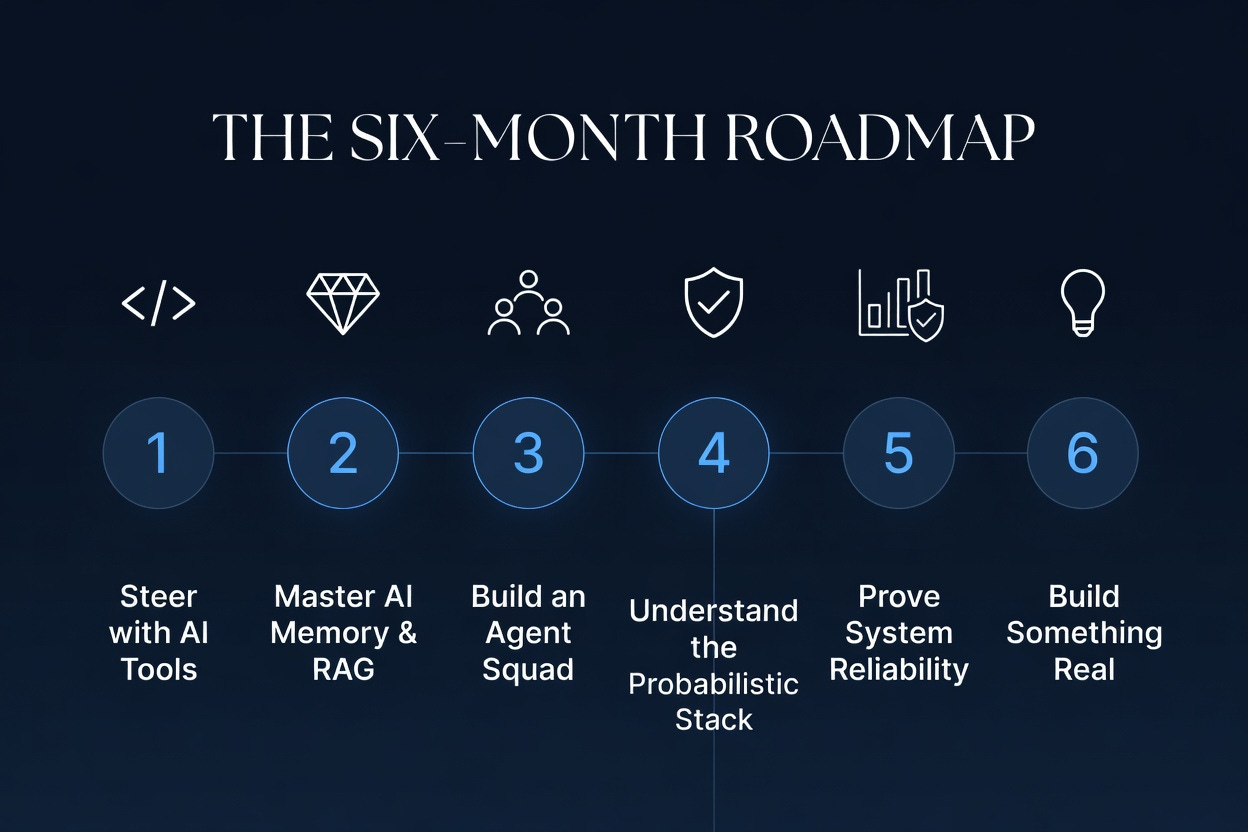
Month one: stop coding like a human. Start steering like an operator. Use Cursor, Windsurf, Claude Code to manage intent across complex codebases. Take a legacy open-source project and refactor it using only agentic tools. Do not write a single line by hand.
Month two: learn how AI memory works. Semantic search, vector databases, RAG. Build something that connects a model to private data without hallucinations. The goal is understanding, not just usage.
Month three: build a squad. One agent writes code, one reviews it, one writes the tests. Create an autonomous bug-hunter that monitors an issue tracker and drafts patches. This is how production AI teams operate in 2026.
Month four: learn to prove a system is reliable. Hallucination detection. Evaluation-driven development. A CI/CD pipeline that runs accuracy tests on agent output. This is work almost no one in most organisations can currently do. That gap is your opportunity.
Month five: understand the probabilistic stack. Token cost, latency, agentic observability. These are systems that do not behave the same way twice. Learning to run them in production is where most people stop. Do not stop.
Month six: build something real. A vertical solution where human judgement is the final gate. A tool that solves a high-value problem that AI cannot solve without you. This is the job description of the person who survives.
Huang is right that dislocation is coming. He is also right that the window to move is still open.
It is not wide. It will not reopen.
📊 The Sunday Signal Tech and AI Layoff Tracker: Week 14
Sourced from Layoffs.fyi and LayoffHedge.com. All figures current to 28 March 2026.
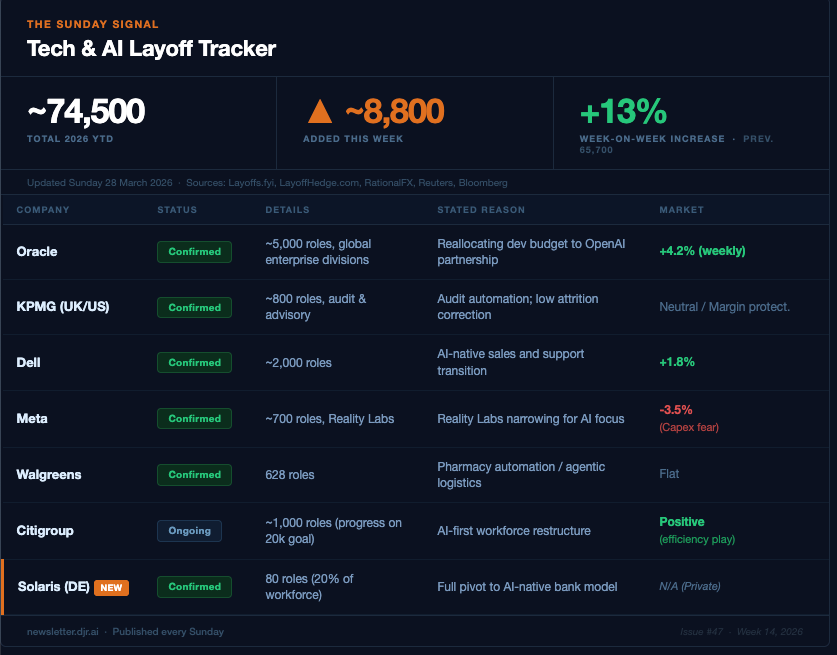
Total 2026 YTD: approximately 74,500 Added this week: approximately 8,800 LayoffHedge sentiment: Extremely Bullish on AI-native restructuring
This is what the transition looks like in numbers.
The narrative has shifted this week from efficiency to liquidation. Companies are cutting human capital to fund the compute clusters required to stay competitive. Eight thousand eight hundred roles in seven days is not a correction. It is a structural event.
The signal this week: the margin-labour swap
For the first time, companies citing AI-native replacement as their primary layoff reason appear to be receiving a median stock price premium of around 9 per cent compared to peers citing macroeconomic headwinds, based on tracker-based estimates. The market is no longer looking for cost-cutting. It is looking for human-to-agent conversion. Employees are being treated as technical debt. Agents are being treated as productive assets.
The KPMG threshold
The KPMG layoffs represent a critical moment for professional services. Eight hundred roles globally in audit and advisory is not large by absolute measure. It is significant for what it signals.
The Big Four model relied on high turnover. Mid-level roles would be vacated as people moved to industry, creating space for the cohort below to move up. That churn has stopped. Because mid-level roles are disappearing from the market due to AI saturation, people are not leaving. The talent is trapped in place. KPMG is cutting because it can no longer wait for natural attrition. The audit agent has arrived and the people it replaces have nowhere else to go.
Watch Deloitte and PwC for announcements in the coming weeks. The KPMG decision will echo.
Oracle and the infrastructure trade
Oracle confirmed approximately 5,000 roles across global enterprise divisions, per tracker-based estimates. The analysis from LayoffHedge frames this as a direct liquidity play to fund its three-hundred-billion-dollar cloud partnership with OpenAI. The stock rose because investors read it correctly: Oracle is selling five thousand salaries to buy GPU clusters.
The logic is brutal and it is now mainstream. Labour is being repriced as operating expenditure. Compute is being repriced as capital investment. Every major institution is running the same calculation.
Next week: the risk heatmap
The Capex Gap analysis for week 14 identifies five companies as highest probability for layoff announcements in the coming seven days. Microsoft is critical. The Stargate funding timeline is creating liquidity pressure in non-AI Azure and hardware units. Salesforce is critical. Agentforce 2.0 is eliminating the sales rep roles that the company simultaneously markets the product to. Deloitte, Alphabet, and ServiceNow complete the watchlist.
In 2026, labour is the new interest expense. The more humans a company carries, the more expensive its balance sheet looks to an AI-first analyst.
🚀 Final Thought
reCAPTCHA extracted six billion dollars of human labour without paying a penny. The offshore model extracted three decades of expert knowledge and fed it into the training data that made that expertise obsolete. The developers who built the best AI tools got managed out because the tools worked.
The machine did not take your job.
You gave it the training data, the workflow, and the permission.
The people who understand the distinction between a job and the tasks within it, between execution and judgment, between being the product and designing the system, those people are not being displaced.
They are being promoted.
Most people will realise this too late.
Until next Sunday, David
David Richards MBE is a technology entrepreneur, co-founder of Yorkshire AI Labs, and a weekly columnist for the Yorkshire Post. The Sunday Signal is published every Sunday at newsletter.djr.ai

Listen to this issue as a podcast. Available on Spotify, Apple Podcasts, and YouTube.