The Sunday Signal: Silence, Bullying and the Cost of Speaking Up
Issue #33 Sunday 14 December 2025. This week: a play about a town bully, the real cost of online silence, and building communities that refuse to look away

The Bottom Line Up Front
We are often told that the right response to bullying is to stand up to it.
That advice is broadly correct. It is also incomplete.
Standing up to a bully is rarely simple, and it is rarely safe. It carries personal risk, social fallout, and sometimes professional consequences. Which is why so many people hesitate, even when they know something is wrong.
Fear is the enabler. Fear of escalation. Fear of becoming the next target. Fear of being isolated.
This week’s Signal looks at how fear allowed a bully to dominate a small town, how the same dynamic now plays out online, and what it takes to build communities where speaking up becomes easier.

Kenrex, Fear and Why Bullying Persists
This week I went to the theatre to see the opening night of Kenrex with Sheffield Theatres at the Phoenix Theatre in London.
At the end of the play, Jack Holden stands alone on stage and disconnects the microphones.
Throughout the performance, those microphones have amplified every voice in the town. Authority figures, gossip, fear, justification, intimidation. They have carried stories, rumours and half-truths. When Holden unplugs them, the sound drops away. The amplification stops. What remains is silence.
It is not a theatrical flourish. It is the argument of the play.
Kenrex is based on the true story of Kenneth Rex McElroy, widely described as the town bully of Skidmore, Missouri. For years he intimidated and terrorised people around him. He was accused repeatedly of serious crimes. Assault, arson, theft, sexual abuse, intimidation. Again and again, cases failed. Witnesses withdrew. Charges collapsed. The law existed, but it never quite arrived.
What the play makes clear is that McElroy was not able to operate because nobody knew what he was doing. He was able to operate because people were afraid.
Fear shaped behaviour in Skidmore. People weighed the cost of speaking up against the cost of staying quiet, and for many, silence felt like the safer option. Over time, that calculation became habit, and habit became culture. The extraordinary became normal. The unacceptable became tolerated.
This is where the advice to stand up to bullies becomes more complicated. Bullies do rely on silence. They do dislike being confronted. But confronting them often means taking on risk alone. Becoming visible. Inviting retaliation. Absorbing consequences that others quietly hope to avoid.
So communities develop a workaround. Sympathy expressed privately. Support offered behind closed doors. Disapproval shared in whispers rather than in public. People convince themselves that quiet kindness is enough.
That is still silence.
Holden, who co-wrote the play with director Ed Stambollouian, plays every role in this ecosystem. The mayor. The DJ. The bartender. The lawyer. The victims. The bully. You do not just see bad behaviour. You see a town slowly reorganising itself around fear.
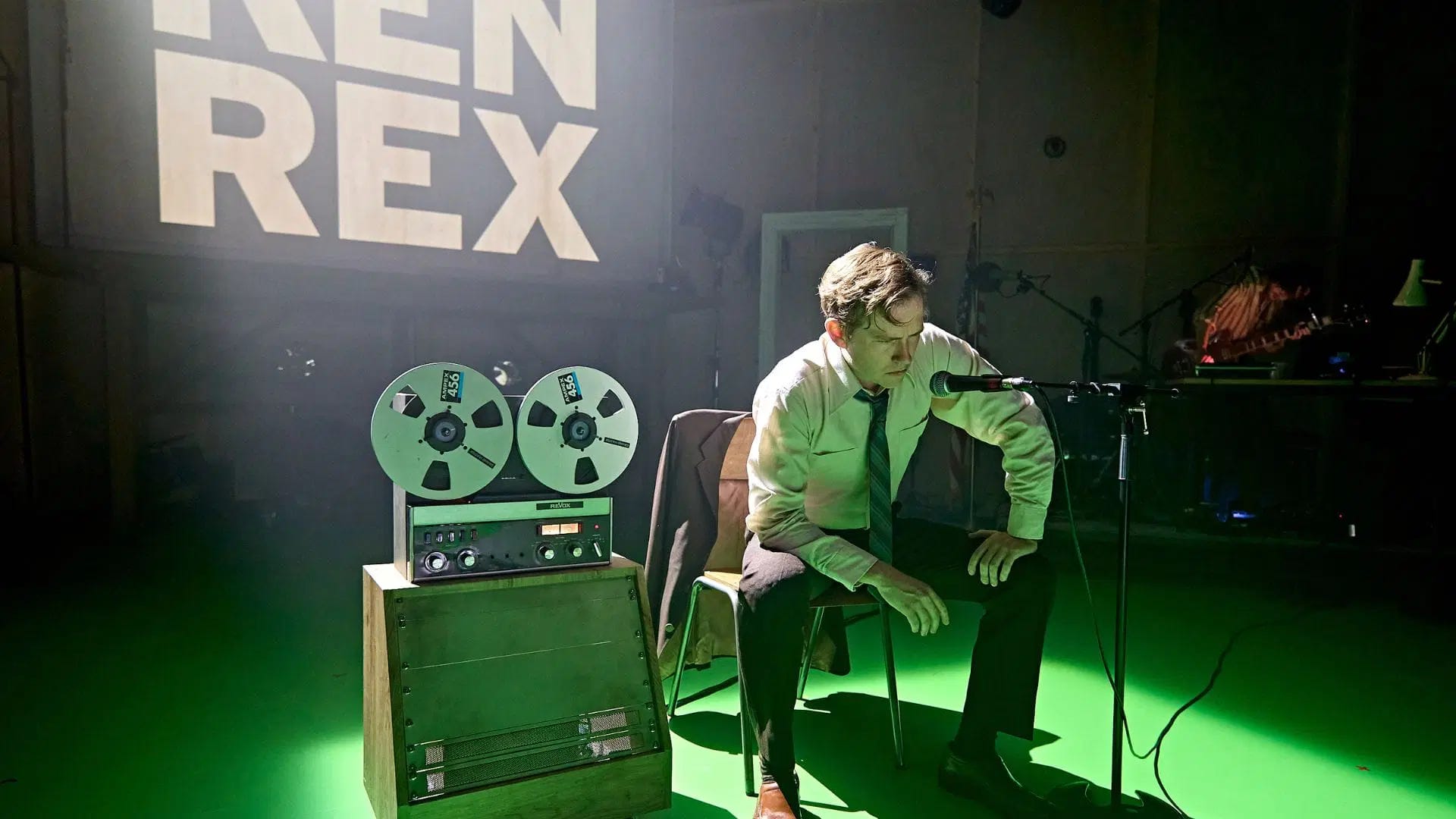
The microphones matter because they represent voice and accountability. When they are unplugged at the end, it reflects the town’s decision not to speak at all, echoing the fact that no one ever came forward, and the killing remains unsolved.
It is also worth pausing on where this work comes from.
Sheffield Theatres has built a reputation for taking creative risks on limited budgets and repeatedly getting it right. Everybody’s Talking About Jamie and Life of Pi both started life there before going on to global success. Those shows did not emerge from caution. They emerged from belief.
Backing work like Kenrex requires the same mindset. It means trusting artists, accepting uncertainty, and taking reputational and financial risk in pursuit of something new. That kind of risk-taking is increasingly rare, which is exactly why it matters.
My view is simple. Kenrex is brilliant. It is totally unique. It deserves a wide audience, and if you can see it, you should. I would be very surprised if this does not go on to an even bigger stage.
Although Kenrex is rooted in 1980s America, its concerns feel entirely current. The mechanism has not changed. Only the setting has.
Today, bullying rarely happens on a main street. It happens on a screen.
Cyberbullying and the Modern Fear Equation
My Yorkshire Post column this week focused on cyberbullying and the persistent belief that online cruelty is easier to ignore than its physical equivalent.
The advice sounds familiar. Do not engage. Rise above it. Do not feed the trolls.
As with Skidmore, that advice contains some truth. But it also avoids the harder reality. Online bullying persists for the same reason it always has. Because standing up to it carries risk.
Digital harassment is rarely a single incident. It accumulates. It repeats. It distorts. It follows people into their work, their families, and their sense of safety. The damage is quiet, but it is relentless.
What makes cyberbullying particularly effective is how it exploits fear in bystanders. Calling it out can trigger pile-ons, misrepresentation, or becoming the next target. So people choose the safer path. Private messages of support. Quiet sympathy. Public distance.
Most people do not join in. They simply decide not to get involved.
That decision is understandable. It is also decisive.
Silence creates the impression of consensus. Consensus emboldens behaviour. Over time, the bully feels untouchable, not because everyone agrees, but because fear has done its work.
The parallel with Kenrex is direct. Bullying survives not because communities endorse it, but because the personal cost of speaking up feels too high to carry alone.
Private support helps people endure. Collective, visible support is what changes behaviour.
A keyboard is not a shield. A platform is not a licence. Harm does not need bruises to be real.
Building Communities Where Fear Has Less Power
The final story this week looks forward.
This week marks the launch of the 2026 Digital Forge Membership. From next year, all Digital Forge events move to a members-only model.
That decision reflects a simple insight. It is easier to speak up when you are not doing it alone.
Events create energy. Communities create safety. Repeated interaction, shared norms and trust reduce the personal risk of saying, this is not acceptable. They turn individual courage into collective behaviour.
Digital Forge exists to bring together founders, engineers, operators and partners who are actively rebuilding British industrial capability. Membership allows us to go deeper. A coherent programme. A shared identity. A community that values contribution and accountability.
The 2026 programme reflects the real challenges facing the region. From Seed to Scale. Female Founders and the Capital Gap. AI and the New Era for Startups. Reindustrialising the North.
Members will also receive first access to live podcast recordings, workshops, trips and the inaugural Digital Forge Awards.
At its core, this is about building environments where fear has less power, and silence is no longer the default response.
To mark the launch, we are offering a 20 percent discount for early members using code FORGE20.
Final Thought
Standing up to bullying is the right advice.
It is also hard advice to follow when fear isolates people.
Kenrex shows how fear allowed a bully to dominate a town.
My Yorkshire Post column shows how the same dynamic now plays out online.
The Digital Forge is about building communities where the cost of speaking up is shared.
Silence often feels safe.
It rarely is.
Read The Sunday Signal first every Friday on Substack.
Public release follows on Sunday.